One of the first posts had to be "introduction to Islam". However, I find there's enough material about Islam itself in books and the web. Moreover, my effort is not to split the hair on the interpretation of what the book says, but instead on how people
live this faith.
In my blogs, a common pattern may be that I'll build up the ground work and lead you into what I want to say. I do this in order to give you the alternative, lay out the finer difference, portray the contrast and build some credibility against verifiable events/facts. If you don't like this style, then just jump to the last few statements.
Islam is just not yet another religionMost people treat Islam, and therefore it's believers, with
a broad brush of generalizing it as yet-another-religious-faith like Christianity, Judaism, Buddhism, Hinduism, etc. Islam is very different from these other forms, and if you try to understand its people based on this "yet another faith" or "how bad can it be" ideology, then you are (in my view) setting yourself up to misunderstanding the religion and its people, as well as not to accept the reality of the situation we are in.
Islam has its own legal system, and requires it to be dominant even in secular systemThe most fundamental difference amongst Islam and other religions is that Islam is a legal system in itself. Islam's basic definition is that it is "simple" and "complete" -- in the sense that it gives people a complete way of life they have to follow. This translates into a key behavior with respect to muslim communities -- they consider perfectly valid to break democratic law, as they can prove that they are still adhering to a legal system created by their God (Allah). This explains many of muslim community choices and behaviors, why they break the law that everyone thinks is fair in treating all humans as equal. It also explains why they can usually justify or silently approve of some gory actions within their community as acceptable, e.g., suicide bomings, terrorism, honor killings, etc. Furthermore, in many democratic nations, muslims have a sharia law alongside the "unified civil code" that applies to all humans -- essentially creating a scenario where there's a "unified civil code" for all democratic human citizens and a little privileges aside for muslims. It sort of distorts the very concept of "uniform civil code" to have "extras" given to a section of its population because they will not accept the law of the land (i.e., their faith will not permit them to be judged by rule of law of the lands they inhabit!). Most muslims have become used to such privileges, and consider not having them as a serious infraction of society and a huge attrocity meted out to them -- hence, take up arms in opposition/response.
Muslim "brotherhood"Another major aspect of muslim behavior that usually evades non-muslim "infidels" (you should know I am joking!) is the concept of brotherhood. In their value system, they see all muslims as brothers, quite literally. Hence, they pain for muslim loses around the world, and are capable of the worst kinds of attrocities to their neighbor, township or country. It is uncommon for many people to comprehend this, therefore, I'll stress the point to explain all that it implies. If a non-muslim dies, muslim value system makes them care less for what happened. It he/she dies in the most horrific way (rape, burnt alive, tortured, beheaded, etc.), mulsims don't get outraged by it just like you wouldn't be outraged at the killing of a chicken for your dinner. There's more strength to that analogy than I originally admitted -- muslims consider their brothers alone as human and everyone else ("infidels") as animals. This creates the social fabric of nations where muslims live -- you can't trust your muslim neighbors to play fair much less protect you when the time comes. For instance, this is what draws out muslims from their economic fabric to contribute their efforts in Palestine, Afghanistan, Chechneya and lately Iraq -- even as the country of their origin gave them everything they wanted and more. Other muslims, who are moderate (and tower in millions) silently and approvingly give donations to these efforts -- while feeling shy and worthless that they themselves cannot travel to those places to fight the "infidels". Finally, a large number of innocent muslims do not fully comprehend "how deep the rabbit hole goes", and just donate without thinking or by being swayed by the "orphans" and the "widows" in the handouts and posters for collecting those donations. All of these actions are like a huge "invisible" toy industry where the invisible toy is the "common God", and everyone is paying their bills to subscribe to this industry -- freely sending them cash and checks for them doing nothing. The recipients of the cash and checks convert those donations into guns for an agenda that is bent on dividing our world into muslims and others ("infidels").
More strict than any other organized religion on EarthOther religions believe in "you and your God", "basis in love for humans and animals as good", etc., Islam has instead defined a "God" (Allah) for you and any deviation from it is punishable by beheading. Islam has defined any deed under the "love of God" definition, and therefore, can justify any kind of activity as valid legally within its system as long as there can be a connection derived from its ambiguous text (that by its nature permits a variety of interpretations). These may be some similarities people of other religions point to when showing Islam is just like any other religion, hijacked by its "organized religion" movement. But in my view, having followed other religions like Christianity and Hinduism very intimately, Islam just is much deeper on the phenomenon than the ones you may be equating to in your religion.
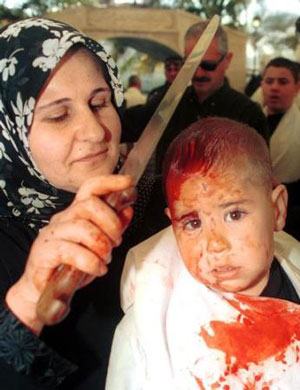
Violent way of lifeAnother major aspect of Islam that manifests itself in muslim behavior around the world is its propensity for violence. Organized religion can be violent, but Islamic teachings are geared towards emotional, passionate and violent displays. You'll witness this "violence as first response" approach in everything about an average muslim -- more so in the fanatics (as is common to many other religions). In an average muslim, the acceptance of violence manifests itself in spouse abuse, elderly abuse and child abuse. It also manifests itself in regular communities using hacking of limbs, beheadings and burning people alive for simplest pretext -- some as simple as a girl refusing to wear a veil or a girl falling love before she is wed to the muslim man or a girl finding love in a non-muslim guy. Of course, revenge and vengeance are corner stone of such societies, where if they lose money in business they'll stab their partners, if they make up their mind that they were "cheated" (as in, interest rate varies after the fact) they'll go in a mob rampage of the town burning shops, buses and people -- and if their muslim brother ("distant brother" in Palestine, while they live in say Indonesia) is killed in battle, they'll mete out revenge on Christian, Hindu or Buddhist families on the roads of their neighborhood. This propensity to equate such emotional passion to the violent blood thirst for their objective, acceptance of it to justify a protest, etc., transform itself into a myriad ways in our society today. Suicide bombers are glorified -- as serving a Godly purpose that's above themselves. Terrorists are seen as using fear and violence as a means to good in the society. Violent scenes are portrayed with a rhetorical agenda to train the young. Children go up seeing fights, hacking, immolations and beheadings on their streets -- creating a new cycle of kids who want to be the "Superman" of suicide bombing, or "Punisher" for non-muslims, or some other super-hero in forwarding the muslim ways of violence onto a secular society that they tend to detest as a wimpy way of life.
- An Apostate Of Islam.